
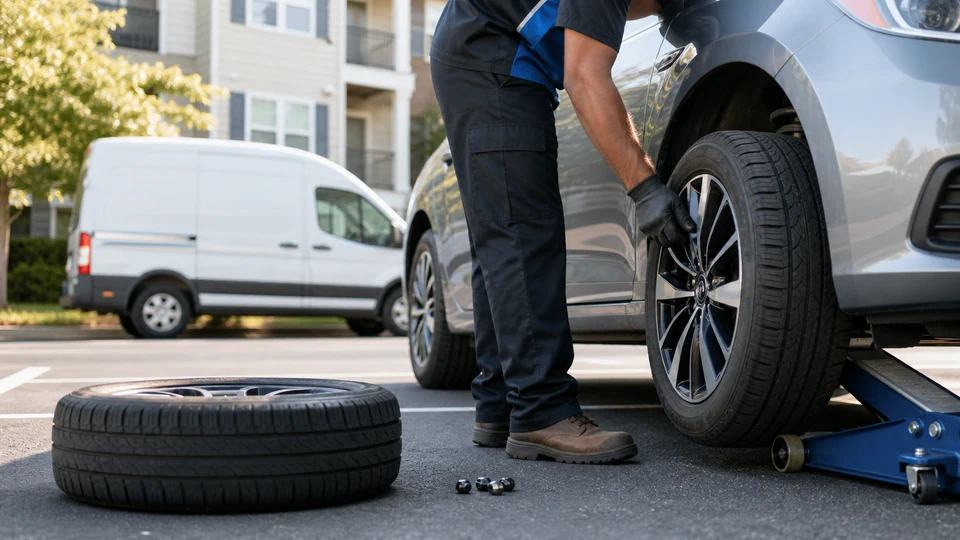
Quick answer: A mobile tire service can bring and install a replacement tire when the correct tire is available and the vehicle is parked in a safe, accessible place. Before dispatch, Amp Rescue confirms the vehicle details, tire size, availability, service location, and price. If the damage can be safely repaired or the vehicle has a usable spare, patching or a tire change may be the more practical option.
When mobile tire replacement makes sense
Mobile replacement is useful when a flat tire cannot be safely repaired and there is no usable spare. It can also help when the vehicle is at home, at work, in an apartment lot, or in another parking area where a technician has enough room to work safely.
It is not the right answer for every flat. A puncture in the repairable tread area may qualify for tire patching after inspection. A vehicle with a safe, properly inflated spare may only need a mobile tire change. Sidewall damage, a large cut, a bulge, exposed cords, or damage from driving on a flat often points toward replacement.
What dispatch needs before checking a tire
Start with the vehicle year, make, model, and exact location. Then send clear photos of the damaged tire, the size molded into the tire sidewall, and the Tire and Loading Information label inside the driver's door.
The door label and owner's manual show the size recommended by the vehicle manufacturer. The sidewall shows what is currently installed. Those details may differ when a vehicle has aftermarket wheels or a previous tire-size change, so both photos are useful. NHTSA advises using the original tire size or another size recommended by the vehicle manufacturer.
Also tell dispatch about any visible wheel damage, a missing wheel-lock key, a parking deck, a gated entrance, soft ground, a steep incline, or limited clearance around the vehicle. These details can change whether the work can be completed safely on site.
How the correct replacement is confirmed
Tire size is only part of the fit. The replacement also needs to meet the vehicle or tire manufacturer's requirements for load capacity and speed rating. The U.S. Tire Manufacturers Association recommends replacement tires with the same size, load index, and speed-rating designation specified by the vehicle or tire manufacturer.
Availability varies by size, brand, vehicle, time, and local inventory. Amp Rescue does not assume that a tire is available based only on a general description such as “SUV tire” or “18-inch tire.” Dispatch confirms a compatible option and provides the quote before sending a technician.
What happens during mobile tire replacement
At the vehicle, the technician first confirms that the location is safe and that the wheel, tire, and surrounding components can be serviced. The vehicle is supported with appropriate equipment, the damaged tire and wheel assembly are removed, and the confirmed replacement is installed.
If the technician finds wheel damage, suspension damage, severe hub damage, or another condition outside the scope of mobile tire service, the vehicle may need a repair shop or tow. Amp Rescue provides roadside tire service, not collision repair, alignment, or general mechanical repair.
Replacement, patch, or spare: what is the difference?
Mobile tire replacement
A compatible replacement tire is sourced, brought to the vehicle, and installed when available. This is commonly considered when the existing tire cannot be repaired and there is no usable spare.
Tire patching
A repair may be possible for certain punctures in the tread area after the tire is inspected. Sidewall and shoulder damage are not treated as routine puncture repairs.
Tire change
The damaged wheel is removed and the vehicle's usable spare is installed. A temporary spare is for limited emergency use, so follow the speed and distance restrictions in the owner's manual and on the spare itself.
Where mobile tire service can happen
Amp Rescue provides mobile tire replacement and related roadside help across Raleigh, Wake Forest, Durham, Knightdale, and nearby Triangle communities. Homes, workplaces, apartment lots, and other parking areas may be serviceable when there is safe access and enough room around the vehicle.
If the vehicle is beside fast-moving traffic, blocking a travel lane, on unstable ground, or in another dangerous position, personal safety comes first. Move to a safer location if the vehicle can be moved safely, turn on the hazard lights, and call 911 when there is an immediate danger.
Common questions about mobile tire replacement
Can Amp Rescue bring a replacement tire to my location?
Yes, when a compatible tire is available and the vehicle is in a safe, accessible place. Tire fit, availability, access, and price are confirmed before dispatch.
Does every flat tire need a new tire?
No. Some tread-area punctures may be repairable after inspection, and a usable spare may be installed when available. Sidewall damage, bulges, severe cuts, exposed cords, and other structural damage generally require replacement.
Can I give dispatch only the tire size from the sidewall?
Send the sidewall photo, but include the vehicle year, make, model, and driver's-door tire label too. That gives dispatch a better basis for checking compatibility, especially when wheels or tire sizes may have changed.
Is a replacement tire always available immediately?
No. Availability depends on the exact tire, local inventory, time, and location. Amp Rescue confirms the available option and quote before dispatch.
Need a replacement tire brought to you?
Call Amp Rescue at (919) 526-5165 with the vehicle year, make, model, tire size, exact location, and photos of the tire and driver's-door label. Dispatch will check whether mobile replacement, patching, or installation of a spare is the appropriate next step.